

How Do You Get Your First Subscribers?
Three Questions Every New Substack Writer Eventually Asks

Recently, a subscriber reached out to me with several questions about getting started on Substack and how to grow a publication from scratch.
As I read through the questions, I realized these were some of the same questions I’ve answered countless times before, whether through direct messages, comments, emails, or entire articles dedicated to the topic. Some of these questions I’ve covered in standalone articles, while others have been discussed across multiple pieces over the years.
This article is perhaps the simplest summary I’ve made on the topic so far.
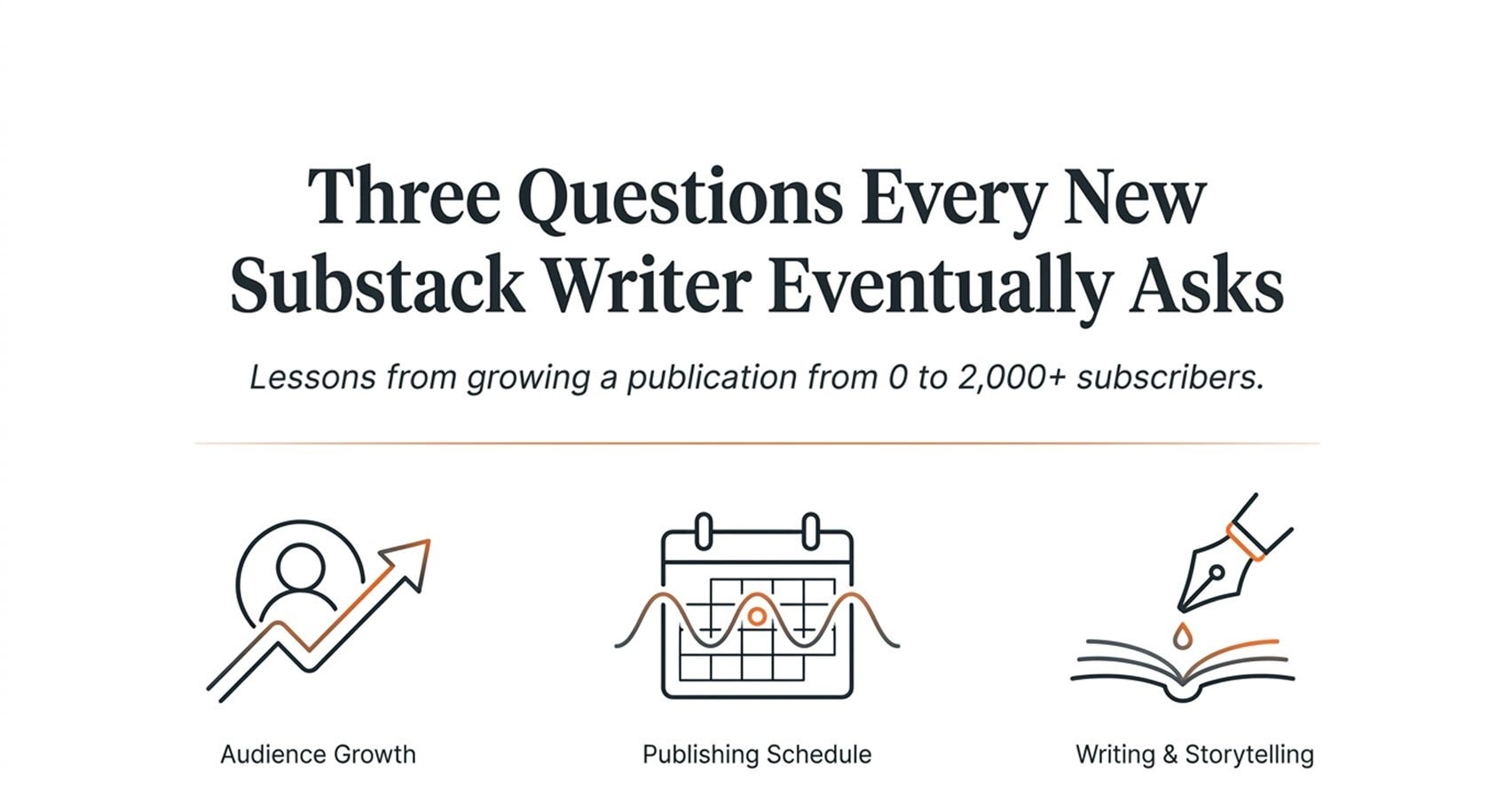
It covers just three of the most common questions I get from new writers and some of the most common challenges people encounter during their first few months on Substack, to make the process a little less intimidating.
Before we begin, a little background.
I started writing on Substack in September 2024.
At the time, I had absolutely no experience building an online presence. I wasn’t active on social media. I didn’t have an audience. I wasn’t trying to become a creator. I simply wanted a place where I could practice writing and perhaps build something meaningful over time.
Today, this publication has grown to over 2,000 subscribers, and I’ve even released a digital product. Those numbers aren’t necessarily extraordinary. Some writers have reached ten times that audience in the same amount of time.
My journey also wasn’t a straight line. During these almost two years on Substack, I was only fully active for about a year. Life happened. My master’s degree demanded more attention. Other priorities emerged. Writing naturally took a step back for a while, and only recently have I begun slowly returning.
With that said, here are three questions that almost every beginner eventually asks.
1. How Do You Get Your First Subscribers?
For this first point, let’s assume you’ve already figured out what you generally want to write about.
Perhaps you’ve already identified the people you want to help. You’ve chosen a niche ot have a topic that you enjoy talking about and want to explore further.
Whatever the case, let’s assume we’re already past that stage.
The next challenge is getting people to actually discover your publication.
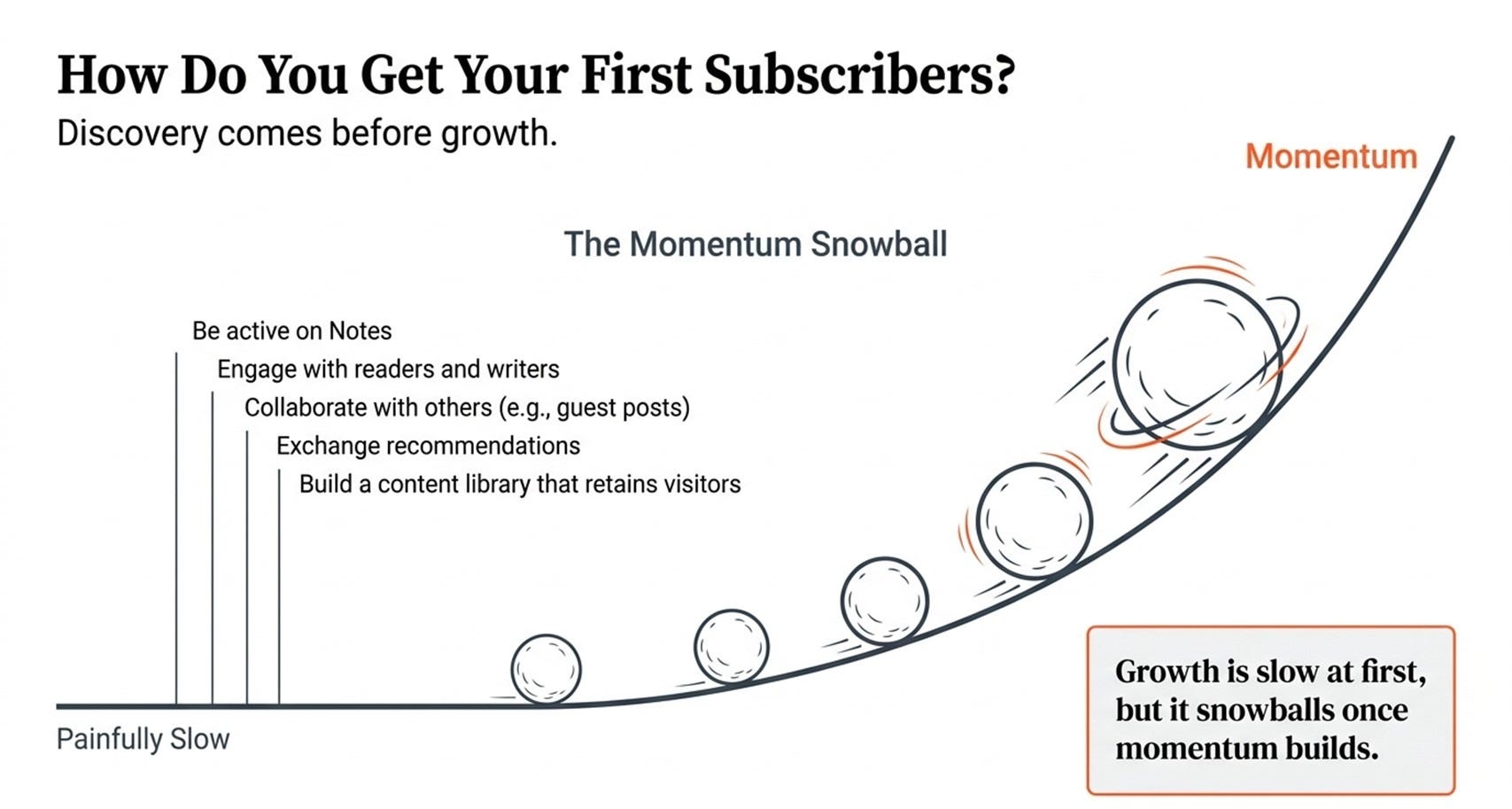
For this question, I think the most effective thing I did was to consistently be active in Notes and engage with my audience and other writers with a similar niche as mine.
People won’t see your articles that much, especially when you have a small subscriber base. Because if you think about it, Substack, as much as it is a social media platform, is still a newsletter.
Most often, the people who see your articles are the ones already on your email list
To invite people to visit your publication and check out your work, you need to be able to pass through their feeds, and the best way to do that is through Notes and engagement.
This is a painfully slow process. However, I can confidently say that once you get the ball rolling, it tends to snowball later on.
Of course, there is no point in getting people’s attention if you can’t retain it.
That’s why it’s important to build a library of content that acts as proof of your expertise and gives people a reason to stay once they arrive.
Lastly, you can also explore collaborations.
Guest posts, interviews, recommendation exchanges, and even simple conversations with other writers can all help expand your reach. The idea is to get your work in front of people outside your existing audience. This tends to work best when you’re collaborating with writers in a similar niche, since their readers are often the same type of people who would benefit from your content as well.
Some of this involves cold outreach, so it’s important to manage expectations.
Not everyone will respond.
Not everyone will be interested.
That’s normal.
2. How Often Should You Publish?
Once people start discovering your work, the next question naturally becomes how often you should actually publish.
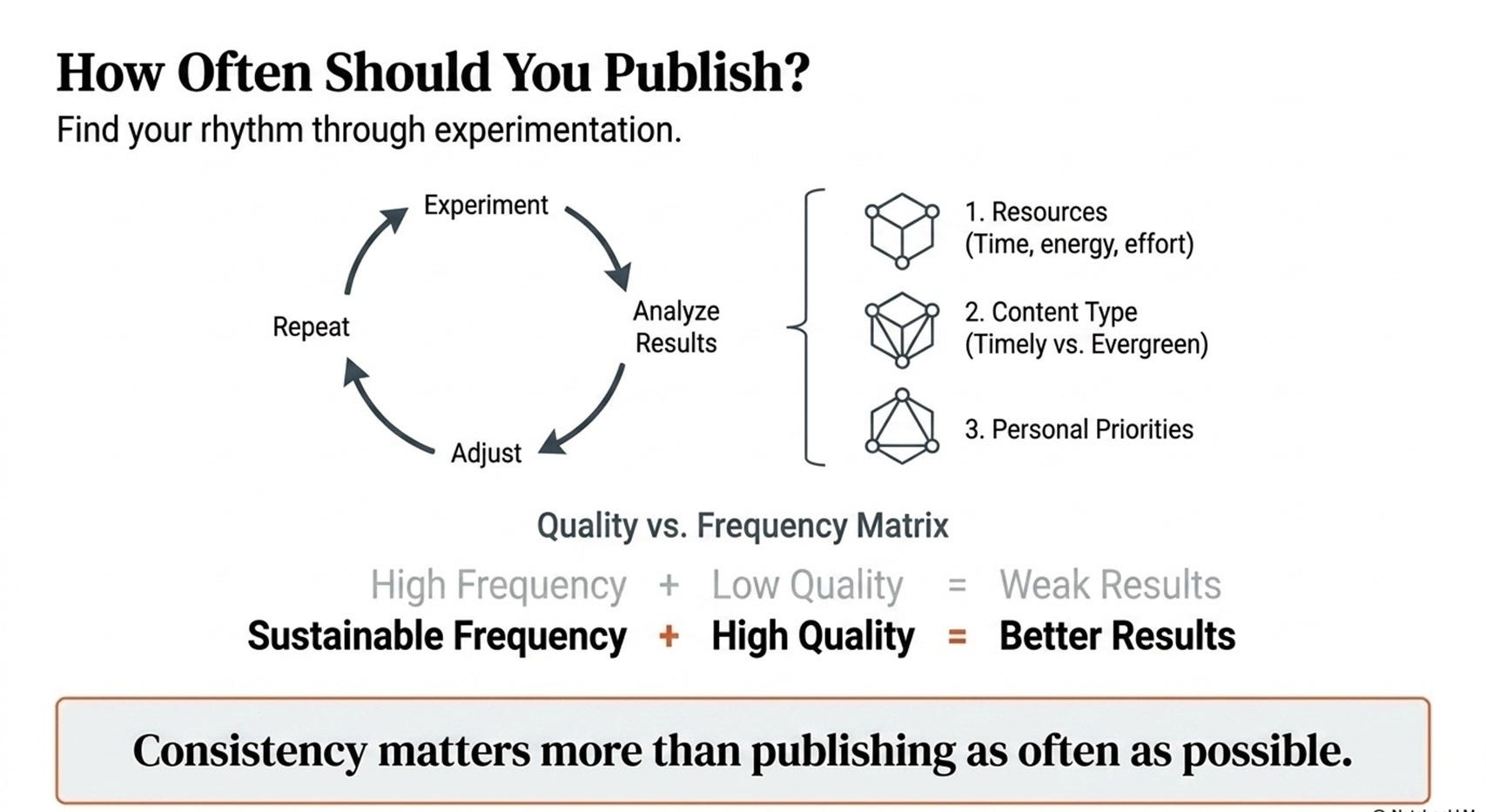
For rhythm and voice, the best place to start if you have no idea what your sweet spots are is experimentation.
For voice, try writing the way you speak.
For rhythm or publishing frequency, I found out that it depends on three things.
a. First is obviously the resources, as in time, energy, and everything else needed by the content that I am producing.
If you notice my profile, I have another publication called Gut-Cha.
This was a publication where I experimented with science-based articles about microbiology and gut health.
Because this type of content requires much more behind-the-scenes work, such as research and fact-checking, the same rhythm that worked for Average Joe’s Guide to Substack, which was 2x a week, was no longer doable, especially as a one-man team where I do the research, writing, and management of the publication.
Hence, I ultimately decided to publish only once a week for that publication, but eventually decided to put that project on hold as I tried to fully focus on this main page of mine.
b. The next factor is the nature of your content.
For me, I consider the content on my page to be somewhere in the middle in terms of pace.
What I mean is that if, for example, you write about trends and analysis in a certain category, news-type content, the rhythm for faster audience growth will usually require a higher publishing frequency compared to content that doesn’t constantly need updating and where the audience isn’t constantly expecting updates.
Which is why I consider this publication somewhere in the middle.
My audience does need to be updated with new things happening on Substack and the topics I talk about, but it is not extremely urgent.
A lot of my content can also be timeless and not necessarily tied to a specific moment. However, they could still benefit from trendy, timely takes.
Then there are types of content that can be extremely slow-moving.
This is how I think about my publication, Poems Before Dying.
That publication is mainly for me to practice poetry and share it.
I don’t think the audience needs constant updates, and they are mostly there to read poems from time to time.
Because of that, my rhythm there isn’t really strict.
I just post whenever I have something to share.
c.The last consideration is somewhat outside the content itself and has more to do with your priorities.
Where does this Substack writing fit among your priorities, and how much can your schedule realistically adjust to accommodate it?
This is completely up to you to evaluate.
If you think you can only give 2–4 hours a week, then maybe 1–2 posts a week is more realistic.
The problem happens when we aren’t clear on this part.
We start thinking we’re doing less than we should, when in reality, we simply promised ourselves more than we can handle.
Sometimes that cycle creates burnout and a constant feeling that we’re not doing enough. Of course, don’t forget to listen to your audience and pay attention to the data.
For example, if you’re publishing 1x a week and then experiment with 2x a week and notice a meaningful increase in engagement, growth, or overall results, then perhaps it’s worth finding a way to sustain that higher frequency.
On the other hand, if you’re publishing 5x a week and compare it to 2x a week, but the difference in growth isn’t that significant, then it may be wiser to stick with 2x a week and invest that extra time elsewhere.
This is why experimentation is important.
Your audience will often tell you what works through their actions and engagement. At the same time, publishing too much is also a real thing. If we constantly force content out before it’s fully ready, quality inevitably suffers.
Readers notice that.
Whether consciously or unconsciously, they begin receiving the signal that not every notification from us is worth opening. And remember, we don’t just appear in someone’s feed.
We appear in their inbox.
Because of that, every email, article, and notification should ideally feel worth their attention. The goal isn’t simply to publish more.
The goal is to consistently publish things that make readers glad they opened them.
In many cases, a slightly lower publishing frequency with higher-quality content will outperform a higher frequency filled with rushed articles.
But once you decide on a specific frequency that fits you, your content type, and your audience, it becomes very important to stick to it because consistency is a clear message to your audience about how committed you are to them.
3. What Should You Write About?
This is the part where we skipped earlier.
We did that because most beginners have already more or less figured out what they want to talk about. They usually have a topic they’re interested in, a group of people they want to help, or simply something they can’t stop thinking about and want to write about.
The problem isn’t usually a lack of direction.
The problem is that once they actually sit down to write consistently, they begin running into a different question:
What should I actually write about?
Or perhaps more accurately:
What type of content should I prioritize?
This happens because; But niche ≠ Content
You may know that you want to write about marketing, fitness, business, productivity, nursing, or any other niche. But that still leaves hundreds of possible articles you could write.
Should you focus on practical tips and strategies?
Should you write detailed how-to guides?
Should you share personal stories and experiences?
Should you talk about mistakes you’ve made and lessons you’ve learned?
Should you write opinion pieces, observations, case studies, or industry analysis?
This is why many beginner writers don’t necessarily struggle with a lack of ideas. Instead, they struggle with deciding which ideas deserve the most attention.
For this one, I think it’s best to make it a mix of both.
While the practical advice is probably where most of your direct value comes from, the philosophies, experiences, and personal stories are often the best vehicles for delivering those lessons and communicating the essence of your work.
One helpful way to approach this is to consider that this whole thing is a two-way process.
You’re looking to build an audience, but the audience is also looking for the best writer they can follow.
One thing that makes Substack unique is that the relationship between creators and readers is much more personal than on platforms like Threads, Twitter, or other social media sites.
As pointed out earlier, we appear in their inbox
That’s a much more personal space, and because of that, we need to justify why readers should let us in.
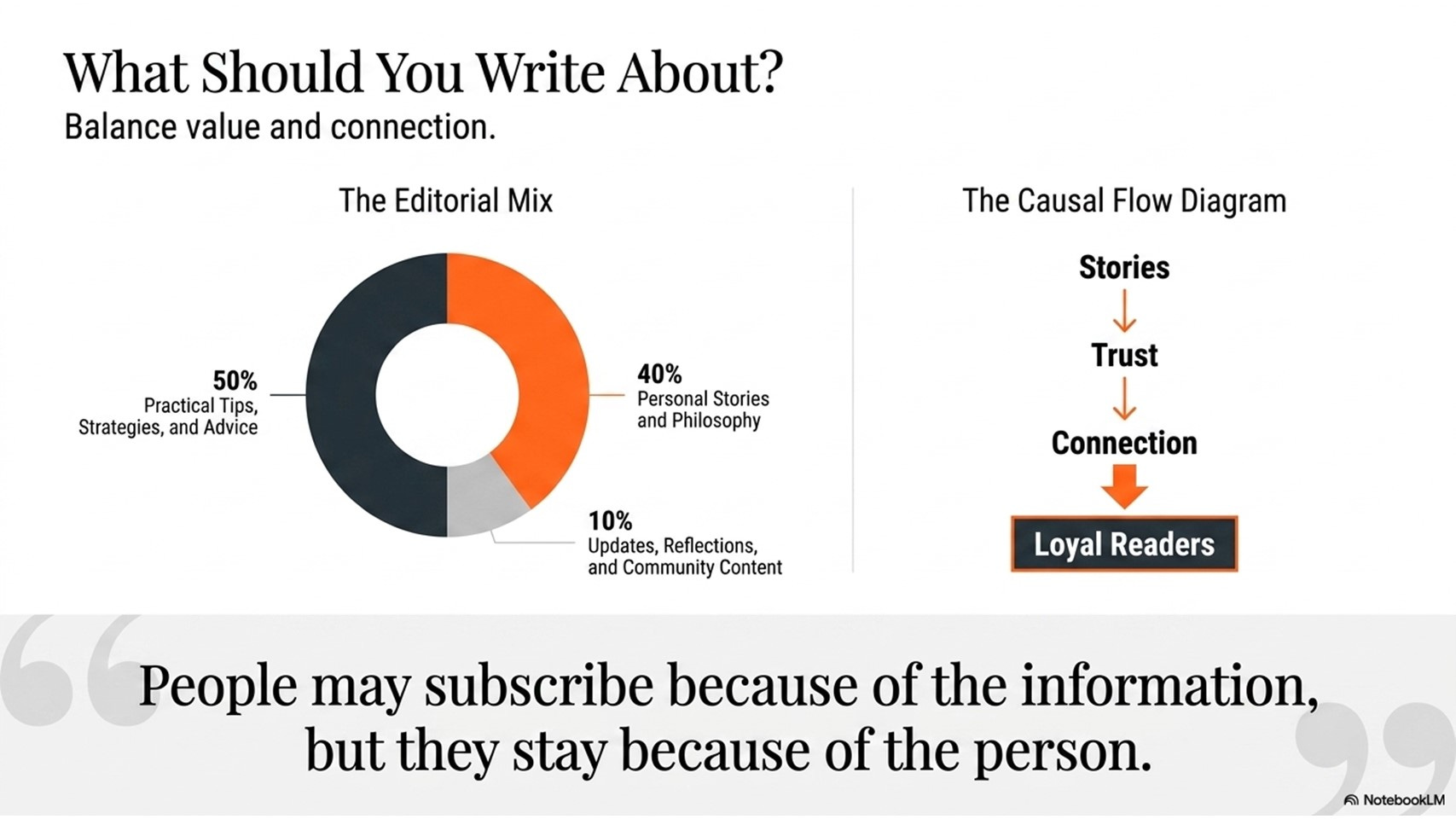
We need to build trust.
We need to create some sense of connection.
And that’s often the role that stories play.
Advice almost always becomes more meaningful when it comes from someone who has actually lived through the experience.
I think this entire article is actually a good example of what I’m talking about.
If you’ve made it this far, chances are you didn’t just stay because of the information.
At the beginning of this article, I shared a little bit of my own story and background. Perhaps you identified with some part of my story or the type of audience this article is for.
That small piece of personal context probably helped you understand who I am and where these ideas are coming from.
After all, this article is essentially a collection of advice.
But advice tends to carry more weight when we understand the person giving it.
That’s one of the reasons stories are so powerful. They don’t just entertain. They provide context. They help people understand why we think the way we do and how we arrived at the conclusions we’re sharing.
In many ways, stories are what transform information into something more relatable and memorable.
And that’s exactly why I believe personal stories and practical advice work best together rather than separately.
40% general philosophies, lessons, and personal stories
10% lighter content such as updates and anything that adds more color and texture to the publication
50% practical tips, strategies, frameworks, and advice-oriented articles
That balance allows you to consistently provide value while also giving readers a reason to connect with you as a person.
People may initially subscribe because of the information.
But more often than not, they stay because of the person.
Before I end, there’s actually an even more fundamental problem related to the question, “What should I write about?”
It is when the context is either you have absolutely no idea what you want to write about, or the opposite, you have so many interests, niches, and directions you could pursue that you can’t seem to commit to any of them.
That’s a topic deserving of a discussion on it’s onw and . If that’s the situation you’re in right now, then this is a good place to start.
That’s all for today! I appreciate you so much for reading up until here! 😊 If you think this article could help someone, feel free to share it or like it it really helps expand its reach to help others as well. 💌
-FREY.