

What Everybody is Doing
When every thought comes from somewhere else, what remains of our own?

Recently, it has been more and more appealing to acquire an idea through fast consumption rather than careful organic development.
The former dominating our current reality is very understandable. There is less friction and is easier to feel more productive.
Our job is being reduced to sifting through endless pools of information and then deciding whether we agree or deny such a piece.
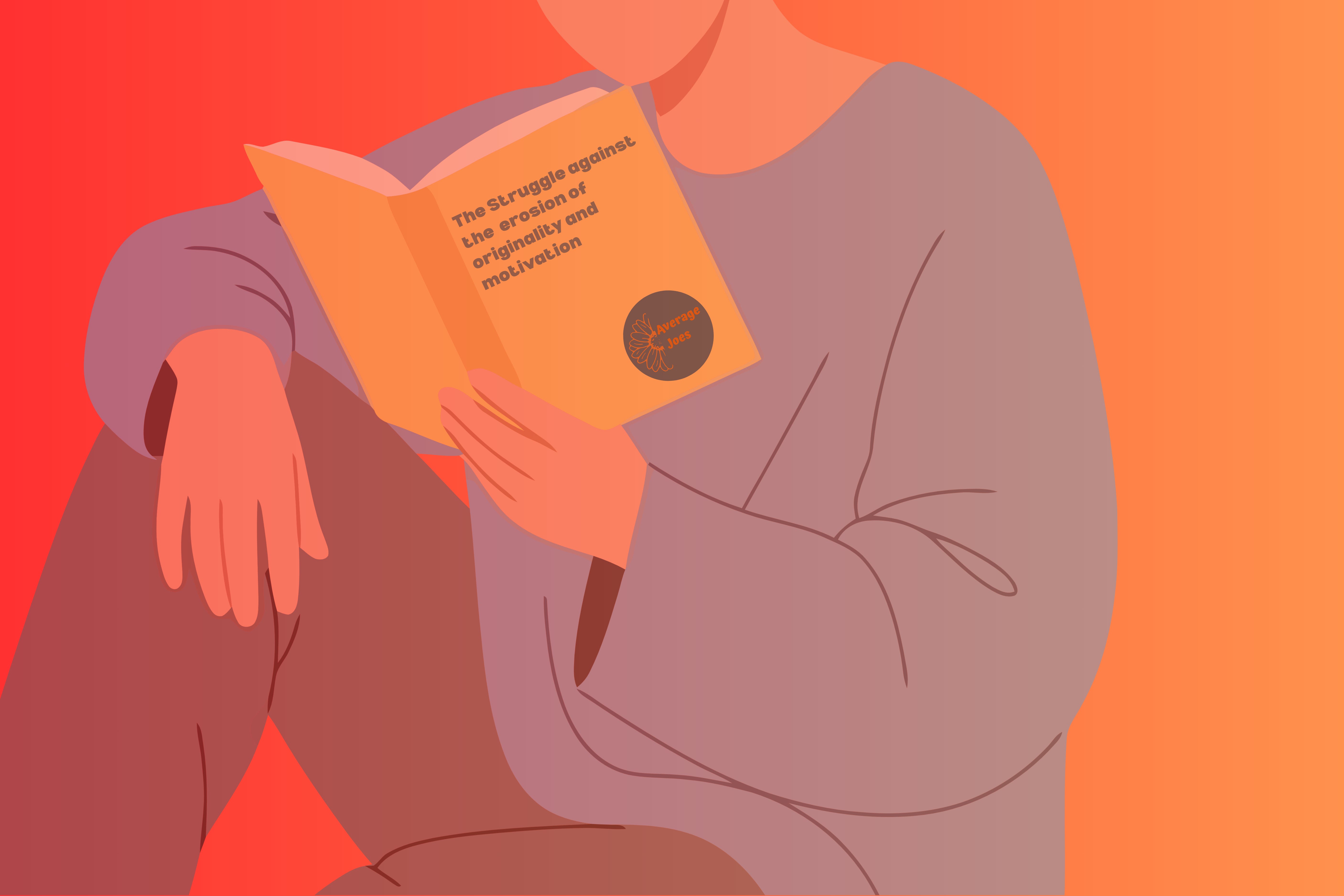
But knowing more cannot replace depth. This depth requires sitting with a thought and exploring every branch of it within the context of one’s reality.
One problem that arises from this overflowing stream of suggestions is the ever-growing uncertainty that accompanies such an abrupt process of forming ideas, identity, goals, and expectations.
Perhaps this is the cause of rampant burnout plaguing different aspects of our daily lives, such as fitness, jobs, and creative pursuits.
I myself am guilty of this; I reduced my entire writing journey to chasing a number because, without realizing it, I’d accepted everyone else’s definition of success, largely shaped by the things I passively consumed.
This created a growing disconnect between me and my craft, making it harder to show up. It felt like I was dragging the other half of my body every time I had to write.
I became all about being faster and more productive. Whose perfect solution was to consume because again it is easier, faster, and more.
Another example is what I see with people who quit the gym prematurely, even though they are already doing great. It’s just that their progress simply doesn’t match the expectations they developed from the marketed version of fitness on the internet. Somewhere along the way, their own goals were replaced by someone else’s standards.
This also causes the growing dependence on external validation.
Since motivation is of an outside source, the simplest way to eliminate the growing uncertainty brought by said disconnect is through external validation.
If one cannot confirm anymore within oneself, it is natural to just ask the source.
We produce and do things that are merely echoes of what we’ve seen, read, or watched.
After all, these are the things the algorithm has already proven to work.
But how is it a problem?
On a more personal level, because motivation is external, it weakens the cultivation of our authentic self and, more importantly, our genuine desire to do things for their own sake.
You run just a little harder when Strava is recording your pace. Or perhaps you cannot even begin your run until you’ve started recording it.
The most amazing sceneries are experienced through the possibility of sharing them. As if the completion of something is for it to be witnessed by others. And if one can no longer show up for themselves, it is hard to expect them to consistently show up for others?
Without realizing it, we become less attentive, less present.
Another reason is that all of these diminish collective creativity (perhaps this is also why we see recurring content dressed in different fonts).
There is little incentive to create something genuinely new.
Originality carries uncertainty. As a result, we increasingly tend to be safe by repeating what has already been done instead of venturing into the unknown.
Again, I msyelf is guilty of this, and it is not to say it is easy to just get out.
To think differently, to create differently, or to live differently risks alienation. Standing apart from the crowd becomes socially expensive, while blending in is constantly rewarded.
And so, genuine conviction is gradually replaced by conformity.
We begin to value belonging over truth, approval over authenticity, and external acceptance over the quiet confidence that comes from knowing who we are.
“The scholar expends his entire strength in affirmation and denial, in criticizing what has already been thought. He himself no longer thinks… the instinct for self-defense has, in his case, become soft.
The scholar is decadent.
This I have seen with my own two eyes; natures gifted, rich, and free, already in their thirties, mere matches that have to be struck if they are to ignite, to emit thoughts.”
- Friedrich Nietzsche
Nietzsche was already worried about someone who only reads books.
Well, right now we are way past that.
Books even give us ample time to self-reflect and decide. What we have now is something much more demanding, and its effects are further exacerbated by the false sense of urgency that you will be left out if you do not put something out as soon as possible.
Look away for a second, and you’ve already missed something. Step away for a while, and it feels like you’ve been left behind.
If there is one purpose behind writing this, it is to urge you to rebel.
And to create is to rebel.
To create is to defend yourself against the degeneration caused by overconsumption.
In a world that constantly asks you to consume, creating is an act of resistance.
Whether it is writing, painting, building, composing, or making something with your own hands, creation is how you process what you have consumed.
The act of creating is an act of discovery.
One does not become creative merely by consuming the works of others. Creativity is cultivated through creation itself. You discover your thoughts by attempting to express them. You discover your values by deciding what is worth making. You discover your voice by hearing it speak before anyone else does.
In a culture that rewards endless consumption, perhaps the most radical thing you can do is create something that did not exist before.
All my articles are free to read. If you’ve been enjoying them and want to show a little love, you can buy me a coffee ☕ using the link below. Your support truly helps me keep creating.
That’s all for today!.
I appreciate you so much for reading up until here! 😊 If you think this article could help someone, feel free to share it or like it it really helps expand its reach to help others as well. 💌
Excellent, and much needed mirror.