

What's Wrong With Your Substack Approach?
The Audience Growth & Visibility Series Part 1

🚨Attention: Substack Writers! 🚨
We’re still running a limited 7-day, 70% off sale on the guide.
Use the code at checkout to claim your discount.
BLACKFRIDAY2025
Most Substack writers, early in their journey, somewhere between 50 to 200 subscribers, struggle
Drowning in advice, but not sure where to start
Learning a lot, but not applying it consistently
Publishing, but not knowing if it’s working or just leading to burnout
That’s why I created a Premium Handbook for writers in that exact stage.
It’s filled with principles, tools, and frameworks to help you master the three core content types on Substack: Articles, Notes, and Subscriber Chat.
If you want clarity, structure, and something that moves you forward, take a look below.
Take a look inside:
Get full access and start building with clarity now!
Gear up so you’re ready when Substack high season hits:
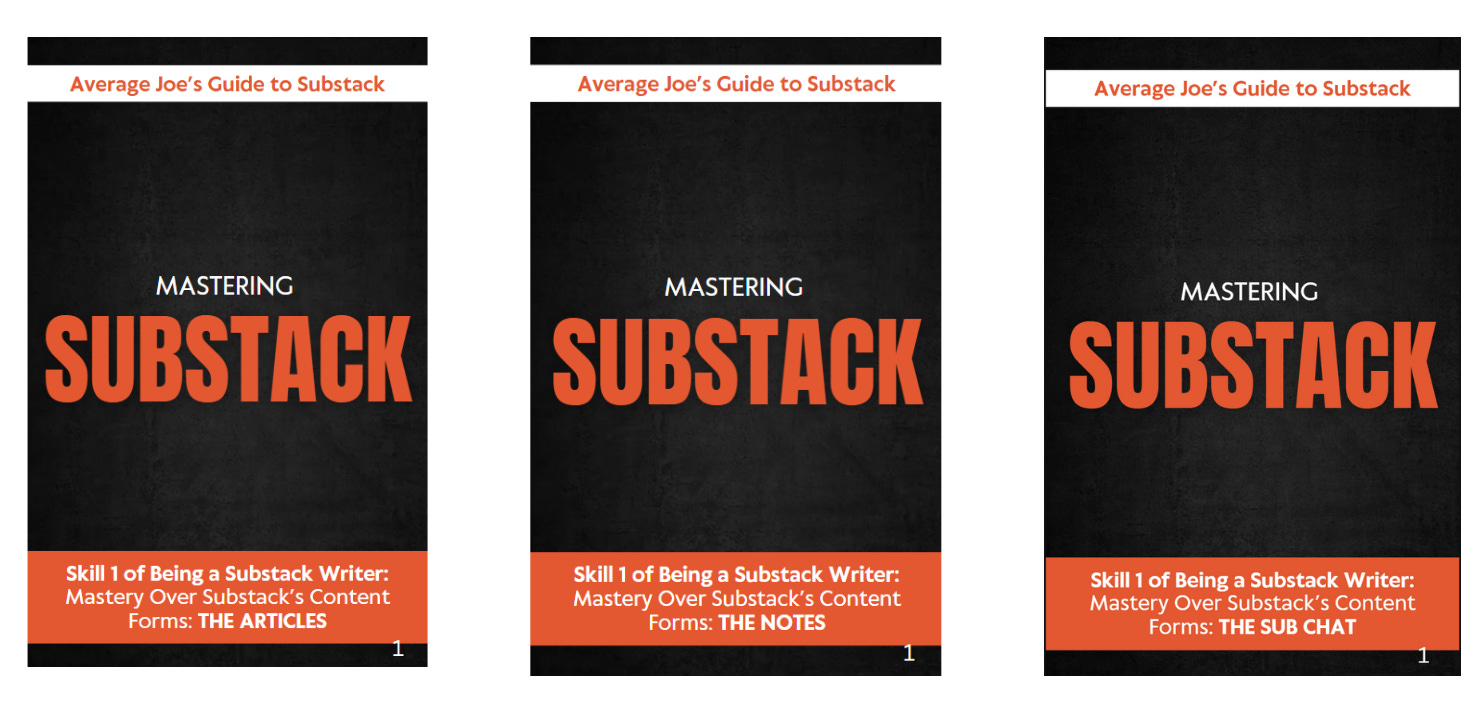
The Article:
Assessing Your Current Visibility
Why Growth Stalls on Substack
You show up, you write, you publish. You’re doing everything you’re supposed to do but your subscriber count has flatlined.
It’s a common and deeply frustrating experience. In a recent survey, writers shared their biggest struggles:
“Hit a subscriber stall”
“Increasing on-site readership”
“My Notes get invisible”
If any of that sounds familiar, you’re not alone. These are also the most common concerns I hear whenever I ask what topics you want me to cover next.
Growth doesn’t happen by accident. When it stalls, it’s a signal: something in your strategy needs attention. But before you can fix it, you have to diagnose the problem.
This post is the first step in that process: a clear, data-driven method for assessing where you stand so you can plan where you want to go.
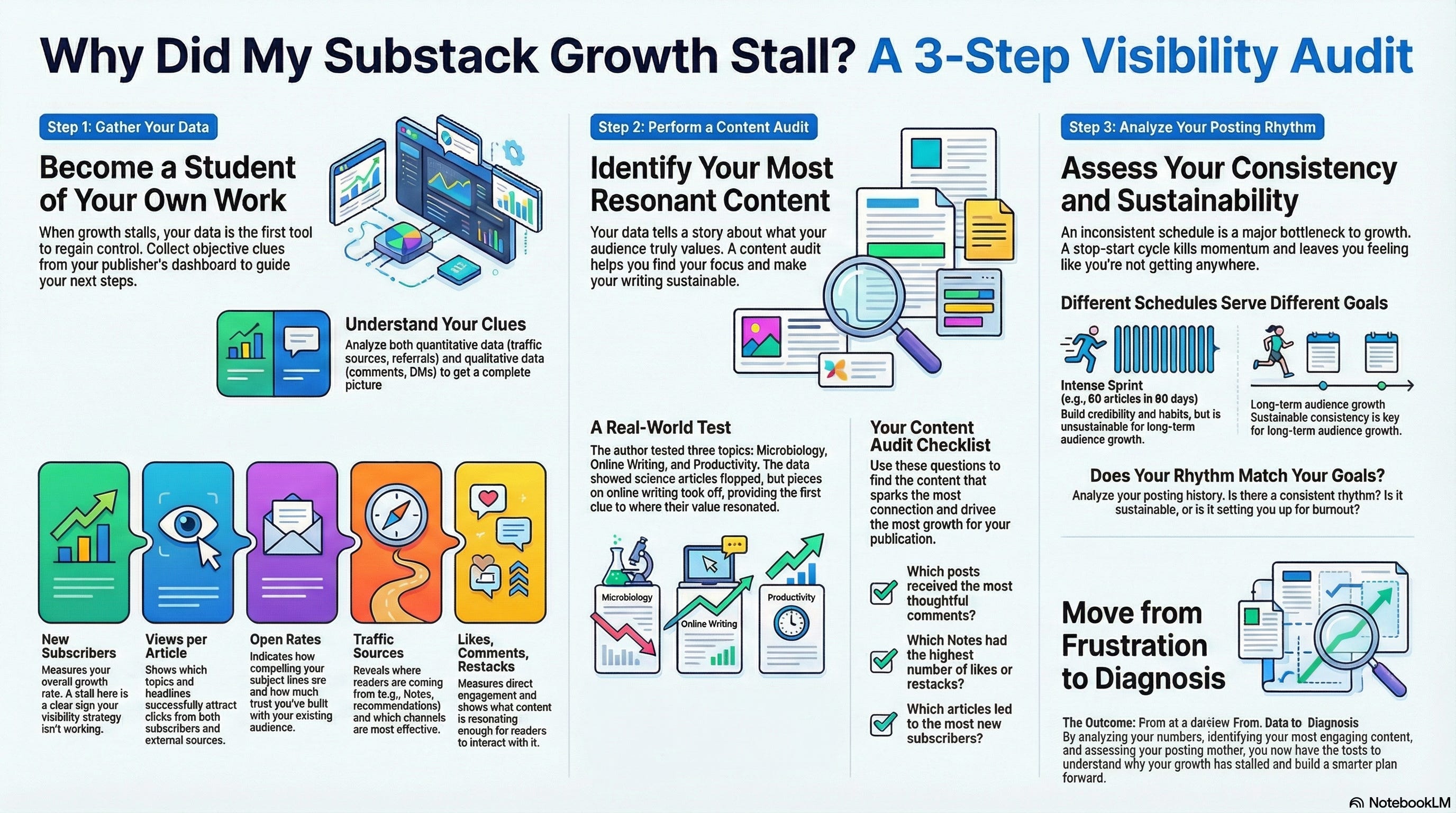
Step 1: Take a Hard Look at Your Numbers
Before changing your strategy, become a student of your own work. When growth stalls, it’s easy to feel powerless but your data is the first tool to take back control. These numbers aren’t just metrics; they’re clues that explain why you feel stuck.
On Substack, you can learn to interpret both:
Quantitative data: traffic sources, referrals, subscriber growth
Qualitative data: comments, DMs, and other audience feedback
Start by opening your publisher dashboard and gathering this information. This isn’t about judgment it’s about collecting objective clues to guide your next steps.
Here are simple metrics to look at as absolute beginners and what do they tell you.
Key Visibility Metrics to Track
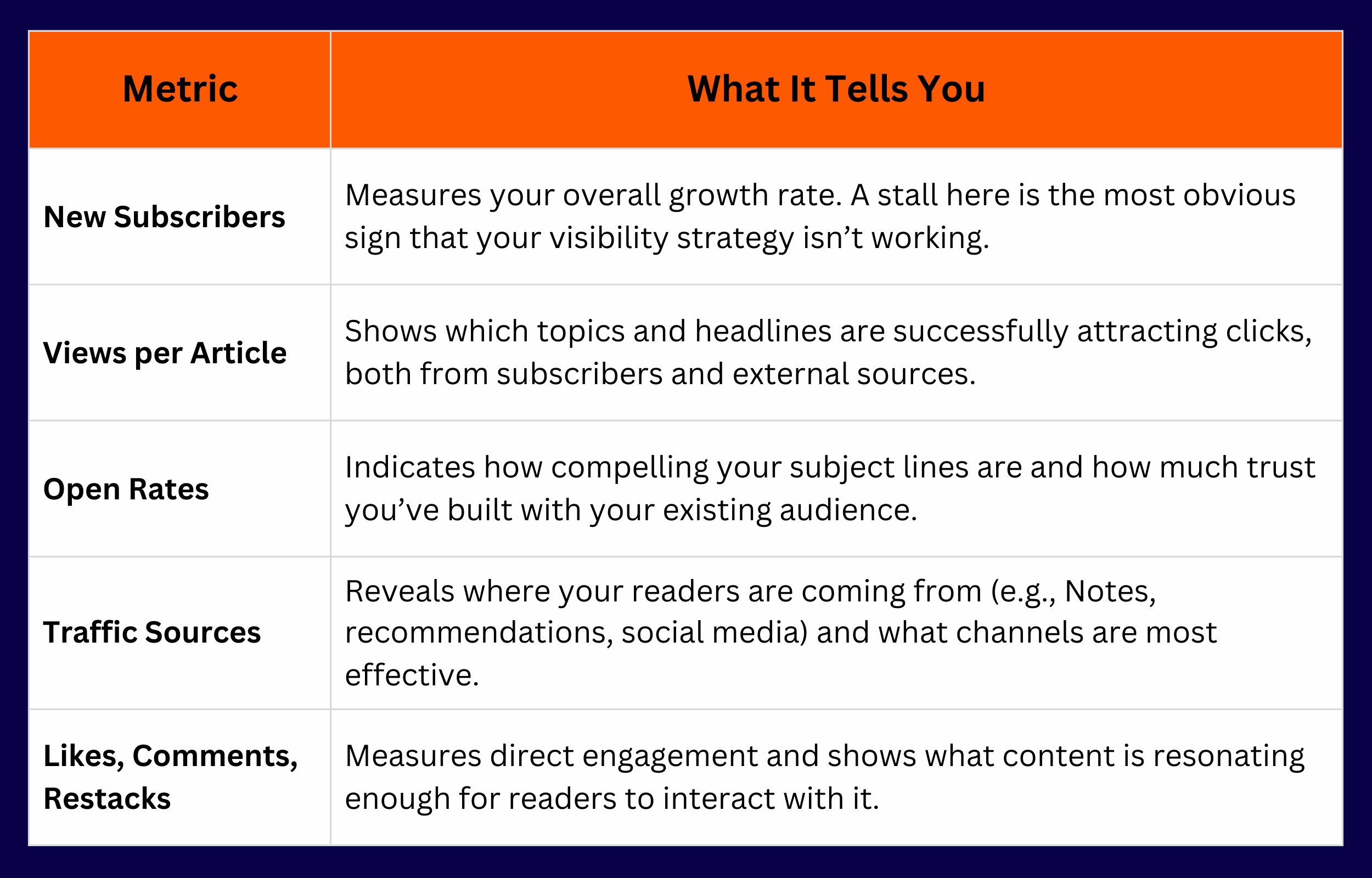
These actions are anchors for small experiments. They let you respond to your data rather than guess, without overhauling your entire strategy.
Step 2: Identify Your Most “Balanced “ Content
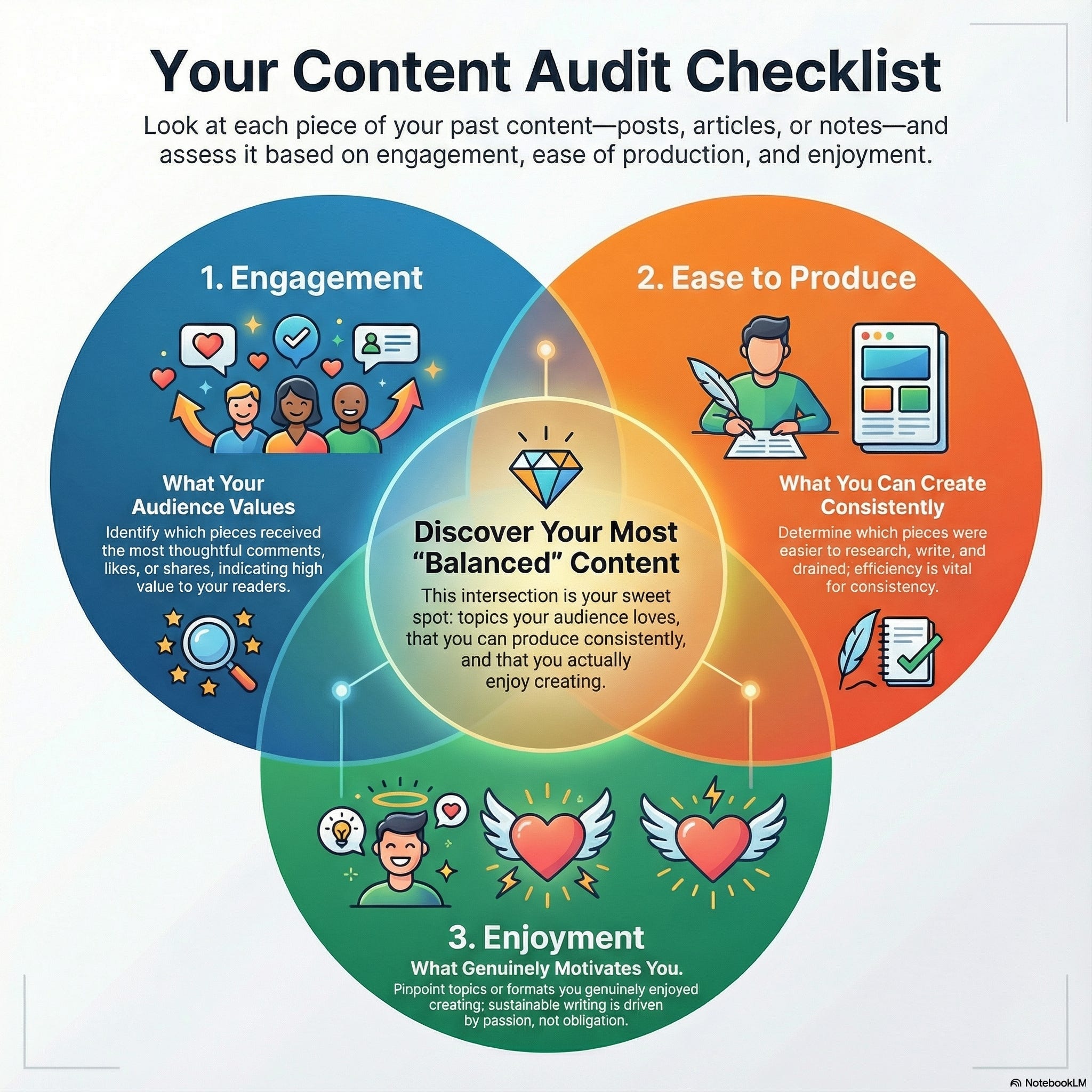
It’s fine to rely on external feedback to see what’s working, but the things that really slow you down and make growth feel hard often come from your side of the coin. By “most balanced content,” I mean the pieces that not only get decent engagement but are also genuinely enjoyable for you to create.
Sustainability is still key.
If you want to survive be sustainable.
Early on, I was all over the place. Writing without direction was exhausting, confusing for readers, and a fast track to burnout.
To figure out what truly resonated, I ran an experiment, testing three topics I was passionate about:
Microbiology: Fascinating to write about, but required a ton of work reading journals, synthesizing technical material and it never quite connected with my audience.
Online Writing: Grabbed great attention, and more importantly, I genuinely enjoyed creating it.
Productivity: The topic I enjoyed writing the most, but it didn’t get much traction.
The results were eye-opening.
That was my first real clue about where to double down on content that consistently got decent engagement and was sustainable for me to create over the long run. Focusing on that became the first step out of the fog.
From then on, showing up consistently felt easier, the dread lessened, and the results started to flow.
Step 3: Analyze Posting Patterns
Visibility isn’t just about what you post it’s also about when and how consistently you post. One of the biggest bottlenecks to growth is an inconsistent rhythm.
A stop-start cycle writing four times one week, then disappearing for two kills momentum and leaves you feeling like a “hamster on a wheel running… not getting anywhere.”
And that’s exactly why Step 2 is so important: it’s not just about chasing what gets the most attention it’s about committing to content you can realistically keep showing up for. Sustainability is the real key to long-term growth.
Different schedules serve different goals. Early in my journey, I published 60 articles in 60 days. The goal wasn’t immediate subscriber growth it was:
Gaining credibility
Building the habit of showing up
Learning pattern recognition
It was intense, unsustainable, and ultimately led to burnout. Later, I shifted to a balanced weekly schedule for long-term growth.
Look at your posting history:
Is there a rhythm?
Is it sustainable?
Does it align with your current growth goals or is it setting you up for burnout?
Step 4: From Data to Diagnosis
Now that you’ve gathered the numbers, identified engaging content, and analyzed your posting patterns, you can start diagnosing the problem.
Take a moment to note:
One or two posts that performed exceptionally well
One or two posts that underperformed
This data-gathering step is the foundation for everything that comes next. In Part 2, we’ll use these insights to build an actionable system designed to increase your reach and restart growth.
Hey, just a small note : everything I write here is free to read. I haven’t put anything behind a paywall.
If you’ve been enjoying the posts and ever feel like showing a bit of support, you can buy me a coffee ☕
It truly helps me keep this newsletter going and allows me to keep everything free.
I’ll keep doing my best to show up and share things that are hopefully useful to you. 💛
That’s all for today! I appreciate you so much for reading up until here! 😊 If you think this article could help someone, feel free to share it or like it it really helps expand its reach to help others as well. 💌
Great article. Well done.
I see this is Part 1. Will we need to purchase additional parts to get all of the plan?