

Stop Sabotaging Your Substack With Your Publishing Schedule
Your Publishing Consistency Isn’t a Discipline Problem

A different article was supposed to air today, but I decided to push this one ahead because you guys seemed to be struggling with this specific problem
For a long time as a Substack writer, staying consistent with a publishing schedule was a painful struggle. This is especially troublesome for someone like me who only does Substack on the side.
I nearly accepted that perhaps I did not have enough discipline for this.
I tried publishing daily, then twice a week, then once.
I also already have experience writing under different categories. I have written a science based publication about microbes in the gut, I have a poetry centered publication, and I have this publication.
Today, I have managed to grow my subscribers and finally understood what was actually wrong.
And it had almost nothing to do with discipline.
Hence, in this article, I will be sharing some factors a writer can consider to increase consistency with their publishing schedule, but more importantly, how to tweak and align these factors so that they agree with not only the writer’s goals but also their reality.
Long form is long. That’s the whole problem.
This does not only refer to the actual length of the piece, it also means the length of the process it needs to be complete.
If you have been writing, you know that (1) conceptualizing an idea alone already takes time.
Then you need to dissect such an idea so that it can form a path, which will become the (2) outline of the piece, an outline where all its parts agree and (3) fill the missing gaps.
After that, you only have, yes, a draft, which you need to (4,5,6,7…..) polish over and over again. If you’re a perfectionist, this will perhaps be the most draining part.
Well, aside from quitting being a perfectionist because perfect is the enemy of good. There are actual concrete steps I have laid out for myself to not only ease the mental strain of writing so many articles, but also just thinking about the process I have to go through just to finish one, which honestly drains me at times even before the work starts.
There are 3 components for this framework:
Component 1: Your Niche and category
This is both very direct but vague, so allow me to break it down using questions.
What category are you in?
What topic do you write about?
Lastly, how much research or preparation does your topic actually require for you to produce one long form article?
What are your goals for the publication? - To just write or grow an audience - (Specific example is discussed in scenario 2-3 below)
Just those three questions tell you a lot of things, and this is how you can use them.
To show you what I mean, let’s use my own publications as examples.
Scenario 1:
Category: Science communication
Topic: Gut health - Specific focus on microbiota
Research requirement: Very high.
This niche and it’s chosen topic is so research intensive hence before I start writing, hours are spent on reading scientific journals.
For this publication, publishing once a week was already my limit increasing the frequency would either force me to reduce the quality or push me to burnout.
Scenario 2:
Category: Creative Writing
Topic: Poetry
Research requirement: Very low.
This is also where goals for a certain publication matters, since growing an audience is not the primary goal for this publication but instead just share my poems and improve faster by doing it publicly
Hence, I did not commit to a very strict publishing schedule and also unlike science , poetry doesn’t require hours of external research. Most of the preparation happens internally reflecting on experiences, emotions, and finding the right words.
Scenario 3:
Category: Personal Development
Topic: Systems, productivity, online writing, and my own experiences.
Research requirement: Moderate to low.
Many of my articles are based on things I’ve personally experienced, experimented with, or observed while building my own publication. I still do research whenever I’m discussing specific strategies or features, but compared to my science publication, much of the knowledge already exists in my own notes and experience.
That means I spend less time researching and more time organizing ideas into something useful for readers.
However, the goal for this publication is specifically to grow an audience so I really made it clear that the publishing frequency should be strict and not only when I feel like it.
Notice how all three are “long-form articles,” yet the amount of work before writing even begins is completely different.
If I expected myself to publish my science articles at the same pace as my personal writing, I’d constantly feel like I was falling behind.
Component 2: You as a writer
Here, what you want to ask is:
How much time can you realistically dedicate each week?
After determining that certain number of hours, you can go ahead and ask:
Where can I fit in those hours?
Then plot them already on your calendar.
Match your publishing schedule to those constraints instead of forcing an arbitrary frequency because someone told you three times a week is the magic number.
The lesson here is simple: don’t copy someone else’s publishing schedule until you understand what their writing actually requires.
The right publishing frequency isn’t the one that grows the fastest it’s the one you can realistically maintain without sacrificing quality or burning yourself out.
Component 3: The Intersection
Since you already know how much time one article takes to be ready, and how much time you can realistically give, combine those two and you now have:
A dedicated time scheduled into your daily life with a specific duration AND
An idea on how many articles you can realistically publish on a weekly basis.
This prevents you from going into a cycle of self blame and asking, “What is wrong with me?” when in reality, perhaps your expectations and goals are simply not made for you.
So you constantly become disappointed, and this is, over time, draining, which is not good for anyone and could even hurt your consistency more or even lead to quitting.
The best practice in online writing is the one that is sustainable because ultimately, the one who can last longer is the one who will reap the fruits of all their efforts.
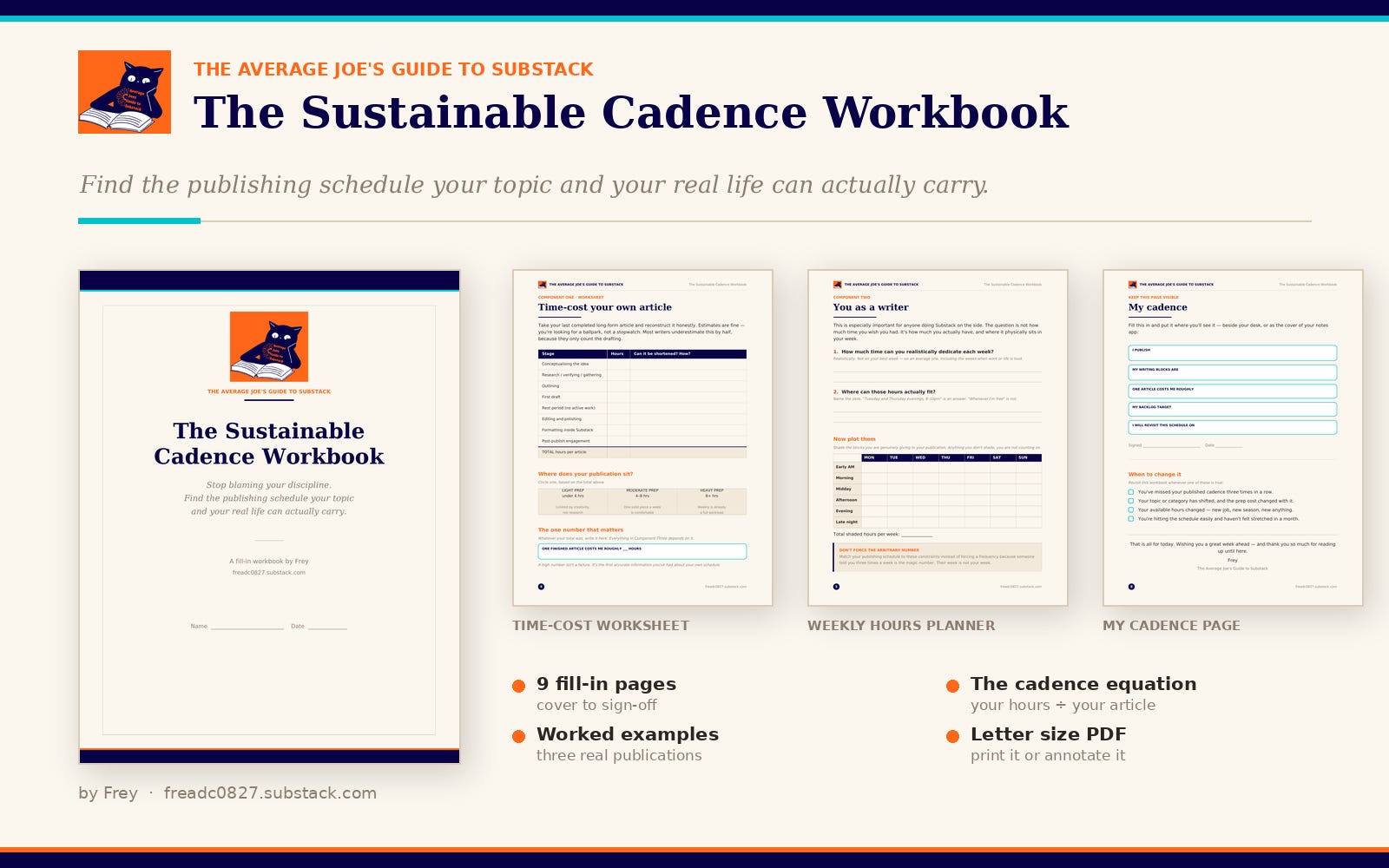
I turned everything above into The Sustainable Cadence Workbook
A guided Nine fill-in pages to help you figure out a publishing schedule you can actually stick to.
Calculate how much time one article really takes, compare it to the time you actually have each week, and find a realistic posting rhythm.
That is all for today! Wishing you all a great week ahead! Thank you so much for reading up until here! 😊
Next time: I shared things you can do in one sitting. Next time, I'll share the small tweaks you can incorporate into your daily life to make the writing process much smoother. So stay tuned for that!
Frey.
All my content is currently free, but if you’d like to support my work, you can buy me a coffee on Ko-Fi! ☕✨ Every bit helps me keep creating contents like these. Thank you! 💛
Speaking of which, I’ve launched a paid membership on Ko-Fi. Members get premium workbooks like the above for free, along with everything else I put together there.
It’s the simplest way to support this publication if it’s been useful to you.
And if that’s not for you right now, that’s completely fine. I keep free resources on my Ko-Fi too, and you’re welcome to pick those up without paying anything. Nothing here is locked behind a wall you have to climb.

💡 Want to go deeper? Subscribe for free to join my subscriber-only chat, where I share behind-the-scenes insights, early drafts, and engage directly with readers on the production of these articles. Let’s build better content together! 🚀
More reads like this:
The Article Pipeline: A Straightforward System to Manage the Article Writing Process

I used to write and publish every single day. I managed to keep up, but my growth was painfully slow, and my articles weren't getting much or any engagement at all, even though I put in at least three times the effort I do now.
This gave me a lot of clarity - thank you!
I started my Substack with one goal in mind a year ago, and along the way establishing the habit of writing regularly awoke my muse. I’m continuing with my original plan, but adding creative writing too. Scheduling posts is giving me a framework to make that possible without overwhelm.